Monday, 18 August 2014

Done & Learned - Quilt As You Go - (II) A bit of practice


This is the second (and last) post about QAYG technique used to make the Spiral Quilt within the section


The first one is here.
Today: a few things about how I did and what I have learned.

I started by designing the layout. A spiral. 
I made the design quite rough. It was for my eyes only, isn't it?


Next I “split” the design aiming to have to quilt only units of reasonable dimensions.
I thought a few versions of the splitting and I adapted the design accordingly. It was my design, so I could do it modifying the squares, rectangles and HSTs dimensions or their positions in rows. Taking into account which is the largest area I can comfortably quilt at my sewing machine, I divided the quilt in units not larger than this one.
I used the Direct Joining method and machine stitching only.
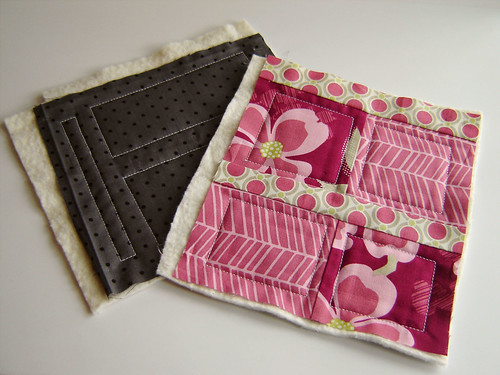
Each unit of the Spiral Quilt was made from three layers: top + batting + backing.

On each unit I left 1" margin unquilted around the edges, necessary when joining layers of one unit to another.
I cut the batting and backing 1” larger than the top.  It is not the best moment to think about how to save a few inches of fabric. It might happen to not have enough backing fabric to finish the joining. 


This method requires cotton batting because it is necessary to use the iron to flatten the layers.
The scissors must be used very carefully when cutting away the batting excess. It’s very easy to cut slits in the top or backing, if you do not pay attention to keep them out of the way while trimming the batting.


 It’s very important that the edges of the batting meet exactly. In situations like in the picture bellow,  hand stitch them together using a large stitch but handle them with much care because they are very sensible to waving, creating bumps when the backing fabrics will be sewn together. The same care is necessary if you use the sewing machine for this.


At over 60” length of the sides, became visible a waving tendency. But working carefully, without pulling in any direction the batting edges, this tendency might be diminished or even avoided.

In order to give a smooth look to the whole quilt my quilting design included the 1” unquilted bands as part of it as the backing joining stitches are visible on the quilt top. This was another way to prevent from bringing a large piece of quilt under the arm of my small sewing machine to complete the quilting pattern.


For sewing the backing folded joining bands the best results I obtained using the regular sewing foot. It worked through all the three layers better than the walking foot. Don't ask me why.

All in all the time consuming was equivalent to the classic technique but I liked it more.

Final conclusion: The Direct QAYG method is useful to solve the problem of quilting a big quilt with a small sewing machine and to organize the piecing-quilting steps so that not waiting too much the latter.

It was fun to use it. 
Trying other QAYG methods is only a question of time and opportunity. 

Have a beautiful day to you all! 

I am linking to Linky Tuesday
                       Fabric Tuesday
                         Let's Bee Social 
                         TGIFF - Devoted Quilter
                         Finish it up Friday


Saturday, 16 August 2014

Done & Learned - Quilt As You Go - (I) A bit of theory

Today I introduce a new section on the blog:

where I intend to gather some of my  impressions after using one or another quilting method or technique. 

As you can see from the post title, this first issue is about QAYG because I promised to share with you what I have learned using this technique at the Spiral Quilt.
This is the first post out of two dealing with the subject: a bit of theory based on practice.
 A short definition:
 QAYG (Quilt As You Go)  is a technique used to make up a quilt by sewing together a few small quilt units or by quilting along with the piecing process.
Why to use QAYG?
In my case: because I have problems keeping together the three layers of the quilt while I am machine quilting it. I use a home sewing machine (Brother Innovis 50) both for piecing and quilting and it is very difficult to manoeuvre a big quilt under its arm. 
 

So I started reading more about QAYG, thinking that maybe I will find some solutions by changing my piecing-quilting methods.
As a few years ago I did an exercise making a quilt using one method of this technique, I knew something about it and I needed an update only.
But after reading and watching a lot of tutorials, the things began to mix up in my head and I had to organize the information.

So in my opinion there are at least three main categories of QAYG methods:

1. Strips joining (sashed)

 source


Described here, here, here, here, here and also here.


2. Direct joining (un-sashed)


Described here, here, here, here, here, here and also here.
 
3. Batting piecing 

source

Described here, here, here, here, here, here and also here.

I didn’t want to theorize the things excessively by giving my own description too to each category.
My point of view is based on the Internet tutorials shared by their authors for free. It’s not an exhaustive study.
I illustrated each category selecting the quilters whom quality of explanation or/and creative manner of using that method are appreciated.
I hope you will find this post useful, not boring!  
In the next one I will briefly share my own experience applying QAYG technique.


Have a beautiful day! 

I am linking to Finished up Friday.


Friday, 1 August 2014

Spiral Quilt at last!

It's the first day of August and I am happy that I begin the last month of summer with this quilt finished.

I've been in stadium to take the photos. I could not find a better place for this. Only that I did not have anyone available to help me and I did not manage to get better pictures.
It is already at its home, on the bed of a special 15 years old boy, that kind of child each of us dreams to have: handsome, clever, ambitious, hard working, cheerful, affectionate, having the right doze of common sense... Told you! The dream child! :)
This summer he passed the exams for admission  to one of the best high schools in the city making his family so happy and proud of him.
So, it was hard for me to find something good enough for him, even nobody thought in these terms. That's why it took me long time to design the top of this quilt. His mother only wish was to have the Runners fabric from Timeless Treasure I showed her a few month ago on the Fort Worth Fabric Studio site.
The rest was my choice.


 After a long period of confusion, suddenly the light bulb has been lit: I decided to use the spiral motif having two of its significances: in the patchwork layout symbolizing the pathway of life and in the quilting design on the border - the ram horns, for strength, ambition, desire to overcome obstacles.


The colours of the solids I used symbolize his favorite sports, the unknowns waiting for him in life, or some others personal aspects.


Most fabrics are Kona Cottons from Robert Kaufman and two solids are from Michel Miller.
I used cotton batting and the wonderful white Kona Cotton for the backing.  I know! You will say it is a little to much for the backing, but my heart didn't let me to choose a poor quality fabric. Not even for the backing.


And one more thing: I worked it using two QAYG techniques. What I have learned doing this deserve a separate post.


Have a beautiful August, my friends!

I am linking to finish it up Friday.
                      Can I Get A Whoop Woop?